Follow Us:



Losing weight can change more than your waistline. After significant weight loss, some people notice that their face looks thinner, more hollow or less defined than before. The cheeks may appear flatter, the temples more prominent and facial lines may become easier to notice. These changes can occur with lifestyle-based weight loss as well as medically supervised weight loss injections in Mumbai.
Facial volume loss is not necessarily a sign that something is wrong. It is often a natural consequence of losing fat from different parts of the body. However, when the change is noticeable, it can affect how rested or youthful your face appears.
The good news is that treatment does not always mean adding back all the weight you have lost. Depending on the underlying concern, options may include nutrition and weight stabilisation, skincare, collagen-stimulating treatments, dermal fillers or other aesthetic procedures.
At MOH Clinics, the first step is understanding whether your concern is primarily volume loss, skin laxity or a combination of both.

Facial fat is part of the natural structure of the face. It contributes to fullness in areas such as the cheeks, temples and around the eyes.
When overall body fat decreases, facial fat can decrease as well.
The extent of facial change varies between individuals because fat distribution is influenced by:
Some people lose relatively little facial volume, while others notice significant changes even after a moderate reduction in body weight.
A slimmer face is not necessarily an older-looking face.
However, facial fat contributes to smooth transitions between different areas of the face. When volume decreases, structures that were previously less noticeable may become more prominent.
For example, you may notice:
The combination of reduced volume and existing age-related changes can make these features more apparent.
It can occur whenever substantial weight is lost.
People undergoing medically supervised treatment with weight loss injections in Mumbai may experience significant changes in body weight over time. As overall fat mass decreases, some patients notice corresponding changes in facial fullness.
It is important not to think of this as a unique effect of one particular medication. Facial volume can change with weight loss from different causes.
The degree of change depends on the individual rather than simply on the treatment being used.
No.
The phrase “Ozempic face” is commonly used online to describe facial changes following weight loss, but it is not a medical diagnosis.
People can experience facial volume loss after weight reduction regardless of whether they lose weight through:
The amount of change also varies considerably between individuals.
What one person considers noticeable facial volume loss may be barely visible in another person.
This distinction is important because different concerns may require different treatments.
You may notice:
You may notice:
Significant weight loss can produce both volume loss and some degree of skin laxity.
In these cases, restoring volume alone may not address every concern, while skin-tightening alone may not restore the lost fullness.
A proper facial assessment can help identify the main contributing factors.
Some people notice that their facial appearance changes slightly after their weight stabilises.
If you have recently completed a major weight-loss phase, it may be useful to allow your body to settle before making decisions about aesthetic treatment.
However, significant loss of facial fat may not completely reverse on its own without some weight regain.
Regaining weight solely to restore facial volume is generally not an ideal strategy, particularly if you have worked toward improving your metabolic health.
Instead, the goal should be to maintain a healthy and sustainable weight while addressing persistent facial concerns separately if needed.
Before considering an aesthetic procedure, one of the most useful questions is whether your weight has stabilised.
If you are continuing to lose a significant amount of weight, your facial appearance may continue to change.
This is particularly relevant for people using weight loss injections in Mumbai as part of a structured weight-management programme.
Your doctor may recommend reassessing your facial volume once your weight has reached a stable point, depending on your individual situation.

Nutrition cannot selectively restore fat to your face, but it plays an important role during and after weight loss.
A balanced diet with adequate protein can support muscle maintenance and overall tissue health.
Important components include:
Extreme calorie restriction can make it more difficult to maintain lean tissue and adequate nutrition.
If you are experiencing unintended or excessive weight loss, discuss it with your treating doctor rather than trying to correct facial changes by substantially increasing your calorie intake on your own.
Facial exercises are sometimes promoted as a way to restore lost facial fullness.
However, they cannot selectively replace fat that has been lost from the cheeks or temples.
Facial exercises may influence muscle tone to some extent, but they should not be considered a replacement for medical or aesthetic treatment when the underlying concern is actual volume loss.
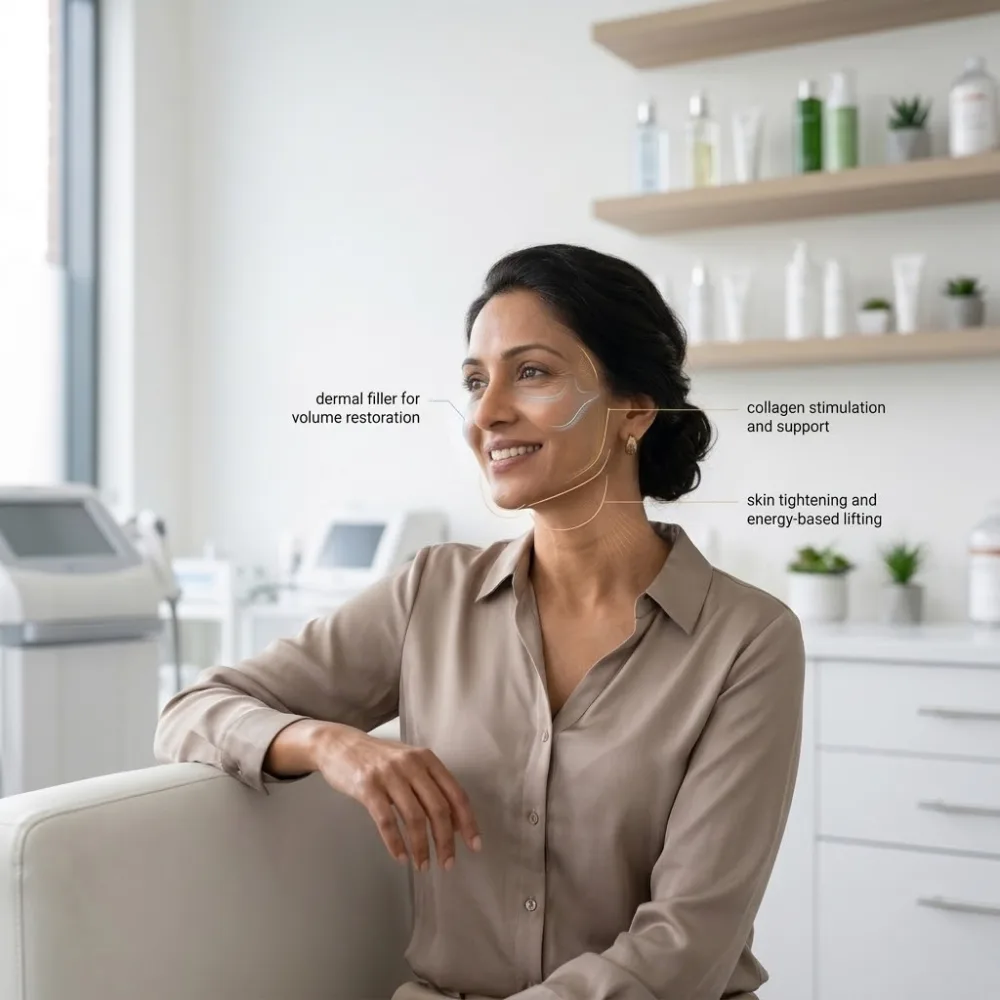
Treatment depends on what you want to change.
Dermal fillers can provide volume to specific facial areas.
Depending on the product and treatment plan, fillers may be used to address areas such as:
Hyaluronic acid fillers are commonly used because they can provide relatively immediate volume and can be tailored to specific areas.
The objective should be restoration rather than overfilling.
Another approach is to stimulate the skin's own collagen production.
Poly-L-lactic acid treatments such as Sculptra work gradually and may be considered for selected patients experiencing facial volume loss and mild skin laxity.
Unlike a conventional filler, the result develops over time rather than relying solely on immediate gel volume.
This can be useful when the goal is a gradual, natural-looking improvement.
If laxity is a significant part of the problem, treatments aimed at improving skin firmness may be considered.
These may include selected radiofrequency, ultrasound or other energy-based treatments.
However, skin tightening and volume restoration address different problems. A treatment designed primarily for laxity will not necessarily replace substantial facial volume loss.
Sculptra may be considered when facial volume loss is accompanied by changes in skin quality or mild laxity.
It contains poly-L-lactic acid, which acts as a collagen biostimulator. Instead of producing the same immediate volumising effect as many traditional fillers, it works gradually to stimulate collagen production.
This makes it a potential option for patients who prefer a more gradual change.
It is important to understand that Sculptra is not a facelift and is not intended to replace significant structural correction.
The appropriate treatment depends on the amount of volume loss, skin quality, facial anatomy and your desired outcome.
There is no universal waiting period.
If you have recently lost a significant amount of weight and are still losing, your facial appearance may continue to change.
Once your weight has become relatively stable, it becomes easier to assess:
Your doctor can help determine the right timing based on your weight-management plan.
Not necessarily.
Modern facial rejuvenation is often focused on restoring specific areas of lost volume rather than making the entire face fuller.
A skilled injector considers facial proportions, symmetry and underlying anatomy when deciding where and how much treatment may be appropriate.
The goal is usually to restore balance rather than recreate your pre-weight-loss face exactly.

There is no guaranteed way to prevent facial volume changes during significant weight loss.
However, a structured approach to weight management can help support healthier body composition.
Important habits include:
Adequate protein can help preserve lean muscle during weight loss.
Strength training supports muscle maintenance and overall body composition.
Aggressive calorie restriction can make it harder to maintain adequate nutrition and lean tissue.
If you are using weight loss injections in Mumbai, follow the treatment plan and monitoring schedule provided by your doctor rather than attempting to accelerate weight loss independently.
Sun protection, avoiding smoking and appropriate skincare can help preserve skin quality as you age.
Volume loss and laxity can occur together.
For example, someone may have:
In such cases, simply adding volume may not address every concern.
A treatment plan might involve one approach for volume and another for skin quality or laxity.
This is why a personalised assessment is more useful than choosing a procedure based only on the appearance of one facial area.
If you are considering treatment after weight loss, useful questions include:
These questions can help you understand the reasoning behind your treatment plan rather than simply choosing a procedure by name.
Facial volume loss can be an unexpected part of significant weight reduction. As body fat decreases, the face may become thinner, cheeks may appear less full and existing folds or hollows can become more noticeable.
If you are undergoing medical weight management with weight loss injections in Mumbai, maintaining adequate nutrition, preserving muscle and allowing your weight to stabilise can help you assess your long-term appearance more accurately.
If facial volume loss remains a concern, treatment can be tailored according to whether the primary issue is lost volume, skin laxity or both. Depending on the individual, options may include dermal fillers, collagen-stimulating treatments such as Sculptra, skin-tightening procedures or a combination approach.
At MOH Clinics, a personalised facial assessment can help determine what is contributing to the change in your appearance and which treatment options may be appropriate. Book a consultation to discuss facial volume loss after weight loss and explore a treatment plan suited to your goals.
Speak with our medical specialists at MOH Clinics in Mumbai for a personalized evaluation, expert guidance on GLP-1 therapies, customized nutrition planning, and dedicated ongoing care.
Book Consultation